First aid is the immediate, temporary care provided to an injured or ill person until trained medical help is available. It does not replace diagnosis or treatment by a healthcare professional. Its main purposes are to protect the person from further harm, support breathing and circulation, control obvious problems such as severe bleeding, and arrange appropriate medical assistance.
You do not need to be a medical professional to provide useful first aid. Staying calm, following a simple order of priorities, and knowing your limits can make your response safer and more effective.
First aid priorities: protect, assess, and get help
In almost every emergency, use this general sequence:
- Protect yourself and others. Check for traffic, fire, electricity, violence, hazardous chemicals, unstable structures, or other dangers. Do not enter an unsafe area.
- Check the person’s responsiveness. Speak loudly and gently tap their shoulder if appropriate. Ask whether they are all right.
- Check breathing. Look for normal breathing. Occasional gasping or irregular snorting is not normal breathing.
- Call for emergency help. Use the emergency number for your country or region. Put the phone on speaker if possible so you can continue helping while answering the dispatcher’s questions.
- Provide immediate care within your training. Follow instructions from the emergency dispatcher and use protective barriers when available.
If the person is unresponsive and not breathing normally, begin CPR and use an automated external defibrillator (AED) if one is available and you know how to access it. If the person is unconscious but breathing normally, place them in the recovery position when there is no suspected spinal injury that requires you to keep them still, and continue monitoring their breathing.
What to do in the most serious emergencies
Unresponsiveness and cardiac arrest
If an adult is unresponsive and not breathing normally:
- Call emergency services or direct another person to call.
- Ask someone to bring an AED, if available.
- Place the person on their back on a firm, flat surface.
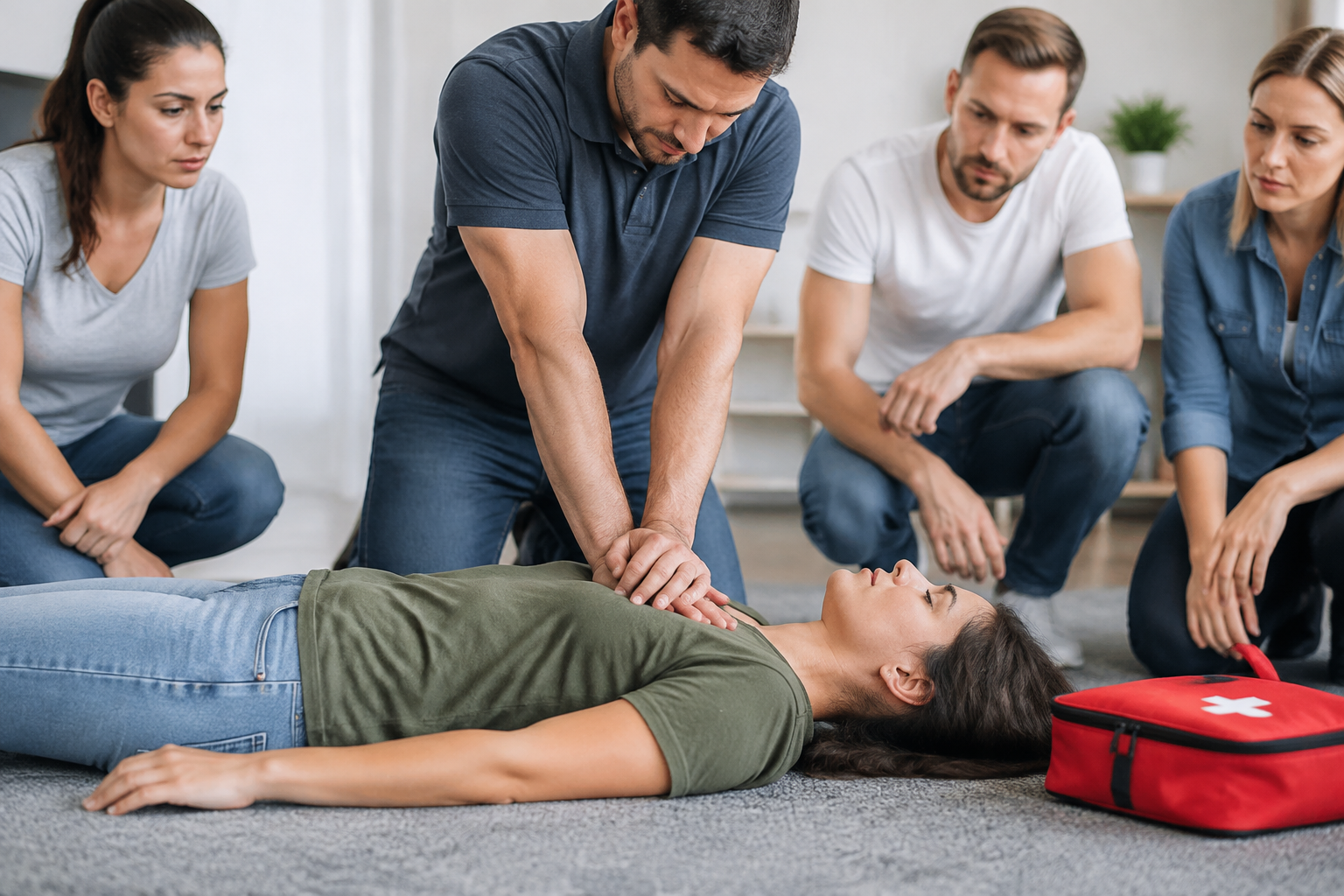
- Begin chest compressions in the centre of the chest. Push hard and fast at a steady rate, allowing the chest to return to its normal position after each compression.
- Use an AED as soon as it arrives. Turn it on and follow its spoken or visual instructions.
If you have current CPR training and are willing to provide rescue breaths, combine breaths with compressions according to your training. If you are untrained or do not want to give breaths, hands-only CPR is preferable to doing nothing for a collapsed adult while help is coming. Children and infants require different techniques, so formal training is especially valuable.
Severe bleeding
Severe bleeding can become life-threatening quickly. Apply firm, continuous direct pressure over the wound using gauze, a clean cloth, or the cleanest available material. Keep pressure on the wound rather than repeatedly lifting the dressing to look at it. Add more material on top if blood soaks through; do not remove the original layer.
If an object is embedded in the wound, do not pull it out. Apply pressure around it and seek urgent medical help. For bleeding from an arm or leg that cannot be controlled with direct pressure, a commercially manufactured tourniquet may be appropriate if you have been trained to use one. Call emergency services promptly and follow dispatcher instructions.
Help the person lie down if appropriate, keep them warm, and watch for worsening weakness, confusion, pale or clammy skin, or loss of consciousness. Do not give food or drink to someone who may need urgent treatment.
Choking
If a person can cough forcefully or speak, encourage them to keep coughing and watch them closely. Do not strike their back while they are coughing effectively.
If an adult or child cannot speak, breathe, or cough effectively, call for emergency help. Give back blows and abdominal thrusts according to your local first-aid guidance and training. Chest thrusts may be used instead in some circumstances, including for certain people who are pregnant or have a larger body size. Infants require a different procedure. If the person becomes unresponsive, lower them carefully to the floor and begin CPR, checking the mouth for a visible object when instructed. Do not perform a blind finger sweep.
Burns
For a thermal burn, remove the person from the heat source and cool the affected area under cool, clean running water for an extended period. Remove jewellery, watches, belts, or loose clothing near the burn before swelling develops, but do not pull away anything stuck to the skin.
Cover the burn loosely with a sterile, non-stick dressing or clean material. Do not apply ice, butter, oils, adhesive dressings directly to the burn, or household remedies. Do not break blisters.
Get urgent medical advice for extensive or deep burns, burns involving the face, hands, feet, genitals, major joints, or airways, electrical or chemical burns, or burns in very young or medically vulnerable people. For a chemical exposure, protect yourself, remove contaminated clothing if safe, and follow emergency-dispatcher or poison-control instructions.
Suspected fracture, sprain, or spinal injury
Keep the person still and support the injured area in the position found. Do not straighten a visibly deformed limb or try to push a bone back into place. Control bleeding around an open injury without pressing directly on protruding bone. Use a cold pack wrapped in cloth for swelling when appropriate, but do not delay urgent care.
After a significant fall, collision, or blow to the head or neck, avoid moving the person unless there is immediate danger, a need to provide CPR, or another urgent reason. Monitor breathing and responsiveness and follow emergency instructions.
Head injury
Seek urgent medical help after a serious impact, loss of consciousness, repeated vomiting, seizure, increasing drowsiness, confusion, worsening headache, weakness, speech difficulty, fluid or blood from the ears or nose, or any major change in behaviour. Keep the person supervised and avoid giving alcohol, sedating medicines, food, or drink if urgent assessment may be needed unless a healthcare professional advises otherwise.
Seizure
Move nearby hazards away and cushion the person’s head. Do not restrain them, put anything in their mouth, or try to force open their jaw. Time the seizure if possible. When the movements stop, check breathing and place the person on their side if they are breathing normally.
Call emergency services if the seizure is a first known seizure, lasts longer than the time specified by local emergency guidance, repeats without recovery, occurs in water, involves serious injury or breathing problems, or affects someone who is pregnant or has another urgent medical concern.
Allergic reaction and anaphylaxis
Signs of a severe allergic reaction can include difficulty breathing, swelling of the lips or tongue, wheezing, faintness, widespread hives, or rapidly worsening symptoms. Treat this as an emergency. Call emergency services and help the person use their prescribed adrenaline or epinephrine auto-injector if available, following the device instructions. A second dose may be needed in some situations, but follow local guidance and emergency-dispatcher advice. Do not leave the person alone, even if symptoms improve.
Poisoning or suspected overdose
Move away from the source only if it is safe. Call emergency services or your regional poison information service and provide the product name, amount if known, time of exposure, and the person’s age and symptoms. Do not make the person vomit and do not give food, drink, or medicine unless instructed by a qualified professional. For inhaled or skin exposures, avoid exposing yourself and follow specialist instructions.
Heat illness and cold exposure
For suspected heat illness, move the person to a cooler place, remove unnecessary outer clothing, and cool them with appropriate methods. Confusion, collapse, seizures, or inability to drink are emergency signs.
For cold exposure, move the person to shelter, remove wet clothing, and warm them gradually with dry layers and blankets. Avoid rubbing cold or numb skin and avoid sudden intense heat. Severe confusion, drowsiness, collapse, or very cold skin requires urgent medical help.
The recovery position
The recovery position can help keep an unconscious person’s airway open when they are breathing normally. Kneel beside the person, place the nearest arm at a right angle, bring the far arm across the chest, bend the far knee, and roll the person toward you while supporting the head. Adjust the upper leg so the person remains stable and continue checking breathing.
This position is not a substitute for CPR. If the person is not breathing normally, begin CPR instead. If a spinal injury is suspected, avoid unnecessary movement and follow emergency instructions.
How to decide what to do first
When several problems are present, use these decision factors:
- Immediate threats to life: absent or abnormal breathing, severe bleeding, choking, and rapidly worsening unconsciousness take priority.
- Scene safety: a rescuer who becomes injured cannot help effectively. Wait for trained responders when the scene is dangerous.
- Time sensitivity: call for help early when symptoms are severe, sudden, or getting worse.
- Age and vulnerability: infants, children, older adults, pregnant people, and people with serious medical conditions may require different care or earlier professional assessment.
- Your training and equipment: use only techniques and devices you understand. Follow product instructions and dispatcher guidance.
- Uncertainty: if you are unsure whether an injury or symptom is serious, seek professional advice rather than relying on guesswork.
What to keep in a basic first-aid kit
A useful kit may include disposable gloves, sterile gauze, adhesive plasters, non-stick dressings, medical tape, triangular bandages, blunt-ended scissors, tweezers, a digital thermometer, antiseptic wipes, a cold pack, a foil blanket, a face shield for rescue breaths, and a small torch. Include any personal medicines or emergency plans prescribed for members of the household, but store medicines securely and check expiry dates regularly.
Keep a kit at home and consider one for a vehicle, workplace, or travel bag. A first-aid kit is not a substitute for training, a phone, or emergency services.
Practical questions to ask during an emergency
- Is the area safe for me to enter?
- Is the person responsive and breathing normally?
- What happened, and when?
- Is there severe bleeding, choking, chest pain, or a serious allergic reaction?
- Does the person have a medical alert bracelet, emergency plan, or prescribed device?
- Can someone call emergency services and guide responders to the location?
- What changes should I report to the dispatcher?
Common first-aid mistakes to avoid
- Do not put food, drink, medicine, or objects into the mouth of an unconscious or actively seizing person.
- Do not remove embedded objects or pull off material stuck to a burn.
- Do not move someone unnecessarily after a serious fall or collision.
- Do not use ice directly on burns or numb skin.
- Do not assume a person is safe because symptoms briefly improve.
- Do not delay calling for help while searching for a perfect first-aid kit.
FAQs
Should I take a first-aid course?
Yes. Practical training is the best way to learn CPR, AED use, choking response, bleeding control, and age-specific techniques. Choose a recognised provider in your area and refresh your skills periodically because procedures, recommendations, and equipment can vary by jurisdiction.
What if I am afraid of making the situation worse?
Protect yourself, call emergency services, follow the dispatcher’s instructions, and provide simple care within your ability. In a life-threatening emergency, doing appropriate basic actions is generally more helpful than waiting for perfect certainty.
When should I call an ambulance rather than arrange routine care?
Call emergency services for abnormal or absent breathing, unresponsiveness, severe bleeding, choking, signs of stroke, severe chest pain, serious breathing difficulty, anaphylaxis, major trauma, suspected overdose, or rapidly worsening symptoms. Local emergency services can help you decide what level of response is appropriate.
Can first aid replace medical advice?
No. First aid is temporary support. Arrange professional assessment for serious injuries, persistent or worsening symptoms, uncertain conditions, or any situation that concerns you.
Are first-aid procedures the same everywhere?
Not always. Emergency numbers, CPR recommendations, medication rules, poison-control services, and legal protections for bystanders vary by country and region. Use local training and follow instructions from your emergency dispatcher.
Key takeaway
For beginners, the most important first-aid skills are recognising danger, checking responsiveness and breathing, calling for help early, controlling severe bleeding, starting CPR when needed, using an AED, and avoiding harmful actions. Training turns these principles into practical skills and helps you respond with greater confidence.
Disclaimer: This article provides general educational information, not medical advice, diagnosis, or treatment. It cannot account for every situation or replace professional first-aid training. In an emergency, contact the appropriate emergency service for your location and follow the dispatcher’s instructions. Seek advice from a qualified healthcare professional for personal medical concerns.