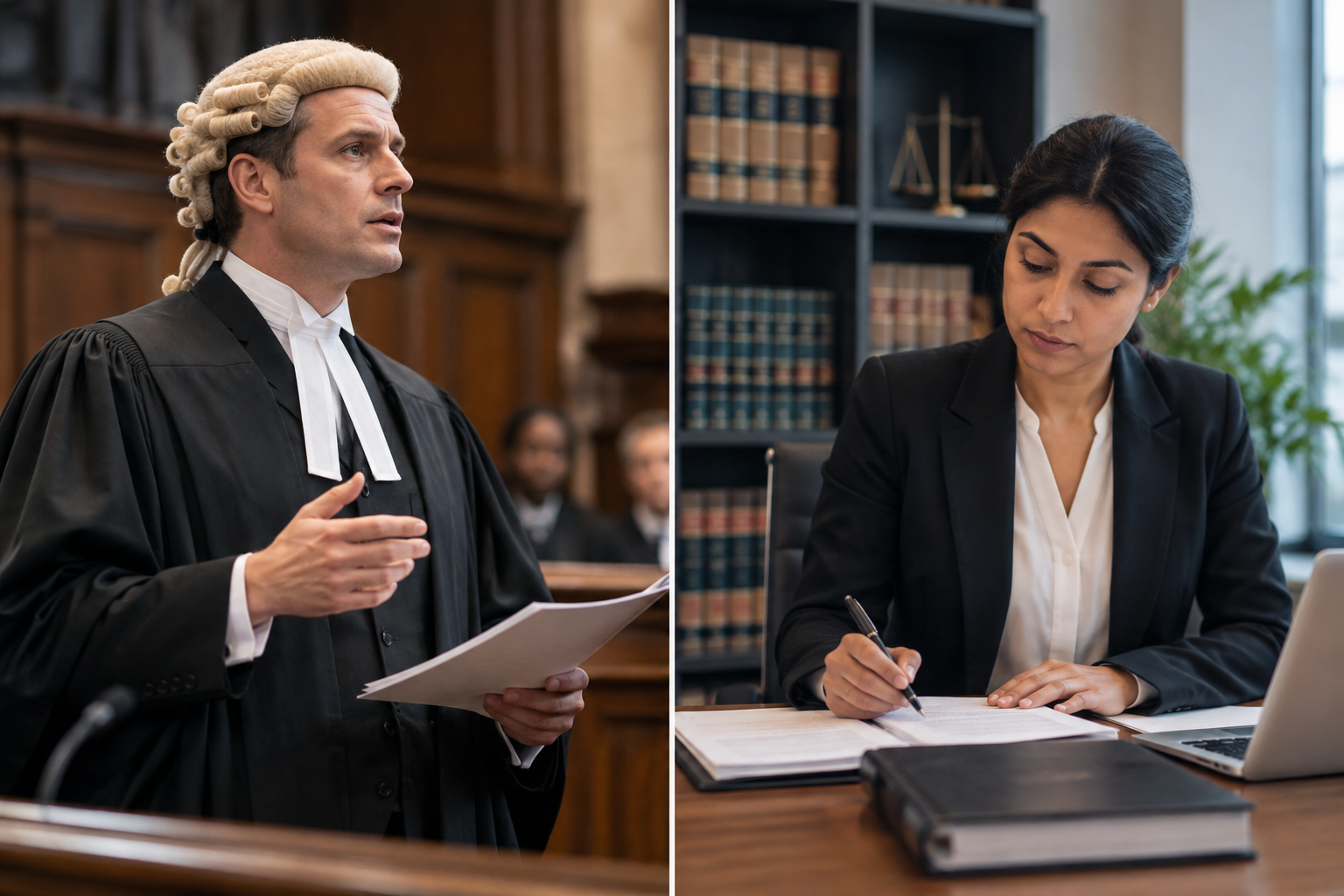
Barrister vs Solicitor: What Is the Difference?
In England and Wales, solicitors and barristers are both legal professionals, but they traditionally have different roles. A solicitor usually manages a client's case, provides ongoing legal advice and deals with paperwork and negotiations. A barrister is generally instructed for specialist legal advice, drafting complex arguments and representing clients in higher courts.
The distinction is less rigid than it once was. Some solicitors have rights of audience in higher courts, some barristers accept instructions directly from members of the public, and solicitors and barristers may work together as part of the same legal team.
This article focuses mainly on the legal systems of England and Wales. Terminology, training routes, rights of audience and professional regulation differ in Scotland, Northern Ireland and other jurisdictions.
Quick comparison
| Area | Solicitor | Barrister |
|---|---|---|
| Typical role | Manages the case and acts as the client's main legal contact | Provides specialist advice, prepares legal arguments and represents clients in appropriate courts and tribunals |
| Client contact | Usually deals directly with individuals and businesses | Traditionally receives instructions from a solicitor, although some barristers accept direct public access instructions |
| Common work | Contracts, conveyancing, employment advice, family matters, disputes and case preparation | Advocacy, legal opinions, written submissions, complex disputes and specialist litigation advice |
| Court work | May represent clients in many courts; rights depend on qualification and authorisation | Often represents clients in higher courts, subject to the relevant rights of audience |
| Business structure | Usually works in a law firm, in-house legal department or public-sector organisation | Often works in chambers as a self-employed practitioner, or as an employed or in-house barrister |
What does a solicitor do?
A solicitor is commonly the first lawyer a client contacts. Their work may include:
- Listening to the client's circumstances and identifying the relevant legal issues.
- Giving legal advice and explaining available options.
- Drafting letters, contracts, statements and other legal documents.
- Negotiating with another party or their legal representative.
- Gathering evidence and managing disclosure or document exchange.
- Preparing a case for a hearing or trial.
- Instructing a barrister where specialist advice or advocacy is needed.
- Keeping the client informed about progress, risks, deadlines and costs.
For example, a solicitor might handle the overall conduct of a commercial dispute, take instructions from the client, correspond with the other side and prepare the evidence. If the dispute proceeds to a complex hearing, the solicitor may instruct a barrister to advise on legal strategy or present oral arguments in court.
What does a barrister do?
A barrister commonly provides specialist legal analysis and advocacy. Their work may include:
- Researching difficult or unsettled points of law.
- Writing formal legal opinions.
- Drafting pleadings, skeleton arguments, written submissions and other specialist documents.
- Advising on the strengths, weaknesses and risks of a case.
- Representing clients at hearings, trials and appeals where they have the necessary rights of audience.
- Questioning witnesses and responding to the arguments made by the opposing side.
- Advising a solicitor or other authorised professional about litigation strategy.
Barristers are often associated with courtroom advocacy, but court appearances are only one part of their work. They may also advise before proceedings begin, help resolve a dispute without a hearing or work on transactions and regulatory matters.
How do solicitors and barristers work together?
In a traditional arrangement, the solicitor is the client's main point of contact and instructs a barrister when appropriate. The solicitor sends the barrister relevant documents and information, explains the client's objectives and asks specific questions. The barrister then provides advice, drafts documents or represents the client.
The solicitor normally continues to manage the wider case. This can include communicating with the client, dealing with evidence, negotiating settlement and coordinating deadlines. The barrister's instructions may be limited to a particular hearing, legal issue or stage of the case.
There is no universal rule that every case needs both professionals. A solicitor may be able to handle a matter without a barrister, while a barrister may sometimes accept instructions directly, subject to the applicable rules and the nature of the work.
When might you need a solicitor?
A solicitor may be a suitable starting point when you need ongoing legal advice or someone to manage a matter from beginning to end. Examples include:
- Buying or selling property.
- Preparing or reviewing a contract.
- Starting or responding to a civil claim.
- Dealing with a divorce, separation or child-related legal issue.
- Handling an employment dispute.
- Setting up or advising a business.
- Making a will or dealing with an estate.
- Responding to a legal letter or regulatory problem.
The appropriate specialist depends on the issue. A solicitor who regularly handles residential property may not be the right choice for a complicated tax dispute, for example.
When might you need a barrister?
A barrister may be useful when a matter involves complex legal questions, a significant hearing or a need for specialist advocacy. You may be advised to use one where:
- The legal point is unusually technical or uncertain.
- Your case is going to a court in which specialist advocacy is important.
- Witnesses need to be questioned at a trial or hearing.
- You need an independent opinion about prospects, evidence or legal risk.
- An appeal or judicial review is being considered.
- A solicitor believes specialist drafting or advocacy would materially assist the case.
Whether a barrister is necessary depends on the facts, the court or tribunal involved, the complexity of the issues and your budget. A solicitor can often explain whether barrister involvement is proportionate.
Can you contact a barrister directly?
Some barristers are authorised to accept instructions directly from members of the public under public access or direct access arrangements. However, not every barrister accepts this type of work, and some matters require the involvement of a solicitor or another authorised professional.
Direct access does not necessarily mean that the barrister will perform every task a solicitor normally performs. Depending on the arrangement, you may need to manage documents, correspondence, procedural steps or administrative work yourself. A barrister should explain the scope and limits of the service before accepting instructions.
Public access rules and eligibility can change, so check the barrister's current authorisation and ask what work they can undertake.
What are rights of audience?
Rights of audience are rights to appear before a particular court or tribunal and address the court on behalf of a client. They are not identical for every lawyer.
Barristers are generally trained for advocacy and may have rights of audience in higher courts, subject to the applicable qualification and authorisation requirements. Solicitors may also have rights of audience, but the extent can depend on their qualifications, practising status and the court involved. Some solicitors qualify as solicitor-advocates and undertake advocacy in higher courts.
You should ask the lawyer who will represent you at each hearing, rather than assuming that the person giving legal advice will also appear in court.
Training and regulation
Solicitors and barristers follow different professional routes, although both must meet the requirements of the relevant legal regulator and complete practical training. The exact route can change over time and may differ according to jurisdiction.
In England and Wales, solicitors are regulated by the Solicitors Regulation Authority, while barristers are regulated by the Bar Standards Board. These organisations set professional standards and provide information about authorisation and conduct. Other regulators may apply to different types of legal professional or to other parts of the United Kingdom.
When choosing a lawyer, check that they are authorised to provide the service you need. You can also ask whether they have relevant experience, professional indemnity cover where applicable and a procedure for handling complaints.
How are legal fees different?
There is no single fee structure for either solicitors or barristers. Fees may be based on hourly rates, fixed fees, staged fees, retainers, conditional arrangements where permitted, or another agreed method. VAT and expenses may also apply.
A solicitor's bill may cover case management, correspondence, document preparation, meetings and work carried out by other members of the firm. A barrister's fee may cover a conference, written advice, drafting or a particular hearing. A barrister's fee for a hearing may not include preparation, travel, additional hearings or unexpected work unless the agreement says so.
Before work begins, ask for written information about:
- The estimated or fixed fee.
- What the fee includes and excludes.
- Whether VAT and expenses are additional.
- What happens if the matter becomes more complicated.
- Cancellation or adjournment charges.
- Payment deadlines and whether money must be paid in advance.
- Whether you could be responsible for the other side's costs if you lose, where relevant.
A quote is not always the same as a guaranteed total cost. Ask how you will be told about changes to the estimate.
How to choose between a solicitor and a barrister
The decision is often not either-or. Consider these factors:
- What stage is the matter at? If you need initial advice or ongoing case management, a solicitor may be the natural starting point. If a hearing or specialist opinion is approaching, a barrister may be appropriate.
- How complex is the issue? Technical legal questions, appeals and difficult evidence may justify specialist counsel.
- Which court or tribunal is involved? Confirm who has the right and practical experience to represent you there.
- Do you need one continuing point of contact? A solicitor usually manages communications and administration throughout a case.
- What can you afford? Ask for a realistic estimate for all stages, not only the first meeting or hearing.
- What relevant experience does the professional have? Look for experience with the type of dispute, transaction, court or tribunal involved.
- Are there deadlines? Legal claims and appeals can have strict time limits. Do not delay seeking advice while deciding which type of lawyer to use.
Practical questions to ask a solicitor or barrister
Before instructing a legal professional, consider asking:
- Are you authorised to handle this type of work?
- How often do you deal with cases like mine?
- Who will do the day-to-day work?
- Will a barrister be needed, and if so, at what stage?
- Who will represent me at each hearing?
- What are the main risks and possible outcomes?
- What information and documents do you need from me?
- What deadlines should I know about?
- What is the likely cost, and what could make it increase?
- How will you update me and how quickly can I expect responses?
- What is the complaints process?
Common misunderstandings
A barrister is always more senior than a solicitor
They are different branches of the legal profession, not simply senior and junior versions of the same job. A solicitor may have extensive expertise, and a barrister may be newly qualified. Experience should be assessed in relation to the work you need.
You always need a barrister for court
That is not necessarily true. The need for a barrister depends on the court, the type of hearing, the complexity of the case and the rights of audience of the professional involved.
A solicitor cannot appear in a higher court
Some solicitors have additional advocacy qualifications and rights of audience. The position depends on the individual lawyer and the relevant court.
Barristers only work in criminal cases
Barristers work across criminal, civil, family, commercial, employment, tax, public and regulatory law, among other areas.
The cheapest initial quote is the cheapest overall option
A low initial fee may not include all necessary work. Compare scope, experience, likely stages and additional charges as well as the headline price.
Jurisdictional differences
The terms and professional roles described here are primarily associated with England and Wales. Scotland generally refers to solicitors and advocates, whose roles and training arrangements differ. Northern Ireland has its own legal profession and regulatory framework, including solicitors and barristers. The Republic of Ireland also has a separate legal system and professional rules.
If your matter involves more than one jurisdiction, ask a qualified local professional which type of lawyer can advise or represent you.
Frequently asked questions
Is a barrister a lawyer?
Yes. “Lawyer” is a broad, commonly used term for someone qualified to practise law. Barristers and solicitors are distinct types of legal professional within the relevant legal system.
Can a solicitor instruct a barrister without asking me?
The arrangement depends on your retainer and the circumstances. A solicitor may recommend instructing a barrister, but should explain why, the likely cost and the effect on your case. Check your client-care documents and ask for clarification if you are unsure.
Will I meet the barrister before a hearing?
Often there is a conference or preparation meeting, but the format varies. Ask whether preparation time, conferences and communication with the barrister are included in the fee.
Can a barrister negotiate a settlement?
Yes, a barrister may advise on settlement or negotiate on a client's behalf when authorised to do so. The exact role depends on the instructions and professional rules.
Can I change from one solicitor or barrister to another?
It may be possible, but changing representatives can create additional cost, delay or procedural complications. Ask about outstanding fees, transfer of documents, deadlines and any hearing dates before making a change.
What if I cannot afford legal representation?
Depending on the type of case and your circumstances, options may include legal aid, a law centre, a legal advice charity, a court or tribunal support service, or a limited-scope arrangement. Eligibility and availability vary, so seek information early.
Bottom line
A solicitor usually manages the overall legal matter and acts as the client's continuing adviser. A barrister generally provides specialist legal advice, drafting or advocacy, particularly for complex disputes and hearings. In many cases, the best approach is for a solicitor and barrister to work together; in others, one appropriately qualified professional may be sufficient.
Start by identifying the legal problem, the relevant jurisdiction, the stage of the matter and the type of support you need. Then confirm the professional's authorisation, experience, role, likely costs and communication arrangements in writing.
Disclaimer: This article provides general information, not legal advice. It does not create a solicitor-client or barrister-client relationship. Professional roles, fees, rights of audience, funding and time limits vary by jurisdiction and by case. For advice about your circumstances, consult a suitably qualified and authorised legal professional.