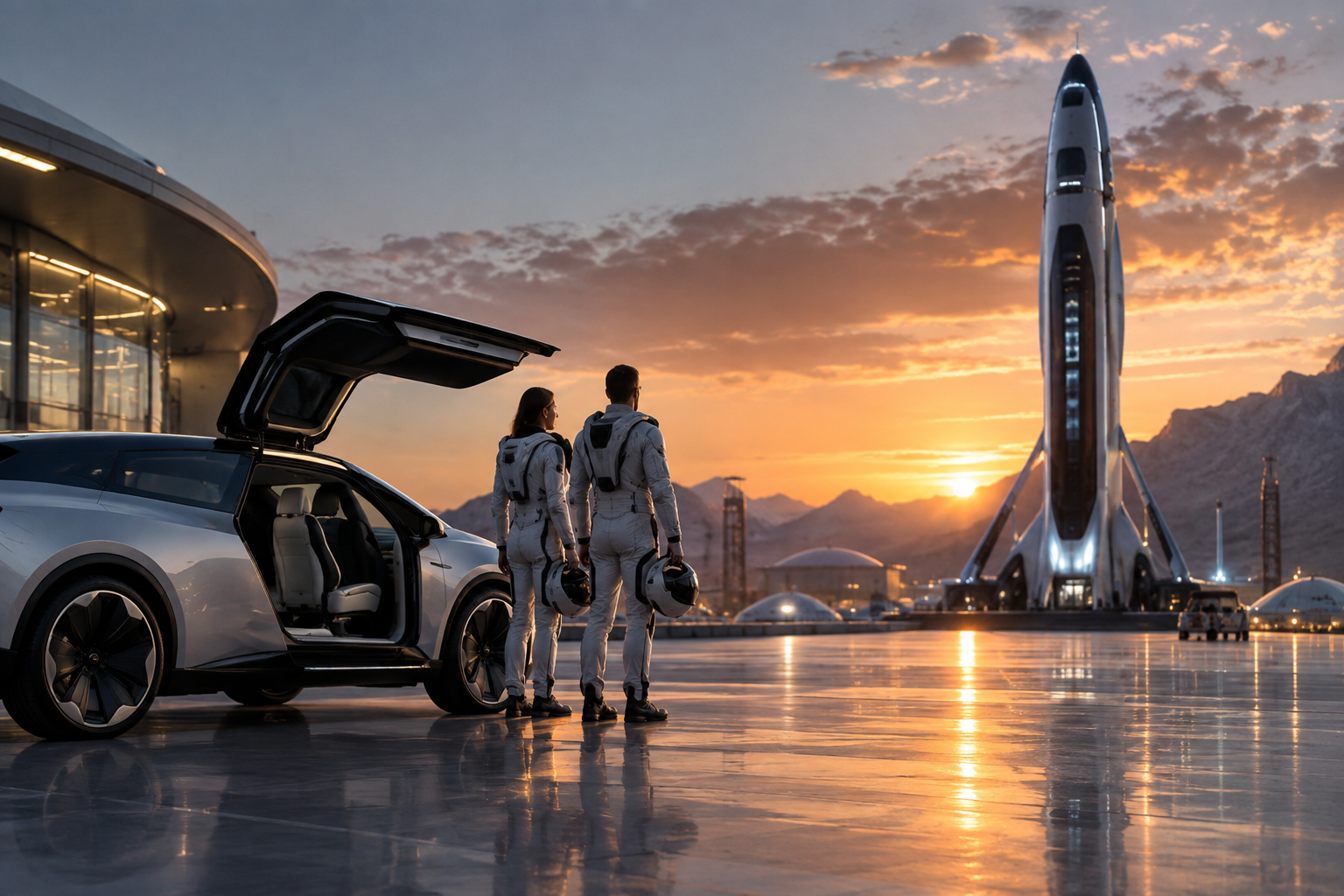
For most people, going to space remains an extraordinary event rather than a normal form of travel. A small number of private passengers have already reached space through commercial missions, but that does not mean spaceflight is close to becoming as routine as flying on an airliner.
The more useful question is not simply whether people will go to space, but what “everyday” means. Occasional space tourism for wealthy customers is one possibility. Regular suborbital trips for a broader market are another. Frequent orbital holidays, commuting between Earth and space, or living in space would require a much larger and more reliable transportation system.
What would count as everyday space travel?
Space travel can refer to several very different experiences:
- Suborbital flights: A vehicle briefly crosses the boundary commonly used to define space, allowing passengers to experience weightlessness and see the Earth before returning.
- Orbital flights: A spacecraft reaches sufficient speed to remain in orbit, creating a longer and more demanding mission.
- Private space-station visits: Passengers stay in orbit for days or longer, requiring life-support systems, training and substantial mission planning.
- Point-to-point space transport: A proposed future service in which spacecraft carry passengers between distant locations on Earth.
- Permanent space habitation: People live or work in orbit or on another celestial body, making space travel part of a continuing transport network.
Suborbital tourism is the most plausible route toward more frequent passenger flights. It is still fundamentally different from making orbital travel an ordinary holiday or transport option.
Why space travel could become more common
Reusable vehicles
Reusable launch vehicles may reduce the amount of hardware discarded after each mission. Reuse alone does not make a spacecraft inexpensive or airline-like, but it can support higher flight rates if vehicles can be inspected, maintained and turned around safely.
Improved manufacturing
Advances in robotics, software, materials and automated production could make spacecraft more consistent and easier to manufacture. Technologies developed for the automotive sector, such as high-volume production methods, simulation and autonomous control, may contribute to this progress. However, spacecraft operate in a far harsher environment and cannot automatically be produced or maintained like passenger cars.
Growing commercial infrastructure
A mature space-travel industry would need more than launch vehicles. It would require spaceports, training facilities, medical screening, mission-control services, rescue procedures, maintenance networks, accommodation and insurance arrangements. Building this supporting system could be as important as improving the spacecraft itself.
Demand from multiple markets
Passenger tourism alone may not support frequent launches. Commercial demand could also come from research, manufacturing, communications, government missions and professional astronaut services. A wider customer base could help spread development and operating costs, although it would not eliminate safety or regulatory challenges.
The main barriers to everyday space travel
Cost
Spaceflight requires specialized vehicles, launch operations, highly trained personnel and extensive testing. Even if launch costs fall, passengers may still face expenses for preparation, medical evaluation, accommodation, insurance and possible mission delays. A lower price would improve access, but affordability for the general public would require a much larger reduction than simply making a few seats available.
Safety and reliability
Rocket launches and atmospheric re-entry involve high energy, complex systems and narrow operating margins. Commercial aviation became routine through extensive testing, regulation, maintenance standards, training and accumulated operational experience. Space tourism would need a comparable culture of reliability before many people would regard it as normal travel.
Passengers should also recognize that a spaceflight may remain inherently riskier than a conventional airline journey, even if operators achieve substantial improvements. The acceptable level of risk is a social, regulatory and personal question rather than a purely technical one.
Human health
Passengers may experience intense acceleration, vibration, motion sickness, disorientation and changes associated with weightlessness. Orbital missions add exposure to radiation, prolonged confinement and the physical effects of returning to gravity. Operators may impose medical requirements, and those requirements could vary according to the vehicle, mission profile and applicable regulations.
Launch and landing infrastructure
Everyday transport depends on convenient routes, frequent departures and accessible terminals. Spaceports may be geographically limited by safety zones, weather, airspace coordination and environmental considerations. A spacecraft could be technically capable of frequent flights while still being impractical for ordinary travelers because reaching the launch site is difficult or schedules are unreliable.
Regulation and liability
Spaceflight is governed by national rules, international obligations and licensing systems that differ by jurisdiction. Questions include passenger informed consent, operator responsibility, accident investigation, emergency response, airspace management, launch licensing and responsibility for damage on the ground or in space. The legal framework may evolve as commercial passenger operations expand.
Environmental effects
Rocket launches consume substantial energy and produce emissions at different levels of the atmosphere. The overall environmental effect depends on the vehicle, fuel, launch frequency, manufacturing process and recovery method. A future industry would face pressure to measure and reduce its impact, but environmental performance should be assessed using complete life-cycle information rather than a single headline claim.
Suborbital versus orbital travel
| Factor | Suborbital travel | Orbital travel |
|---|---|---|
| Mission duration | Usually brief, with a short period of weightlessness | Potentially days or longer |
| Technical demands | Requires launch, controlled ascent and safe re-entry | Also requires orbital insertion, life support and orbital operations |
| Passenger preparation | May involve shorter training, depending on the operator and vehicle | Generally requires more extensive preparation and contingency training |
| Potential path to wider access | More plausible as an initial commercial tourism model | More difficult to make routine because missions are longer and more complex |
This distinction matters because predictions about “space tourism” sometimes combine brief suborbital experiences with much more ambitious orbital travel. Progress in one category does not guarantee progress in the other.
Decision factors for evaluating predictions
When assessing a claim that space travel will soon become ordinary, consider these questions:
- What type of travel is being discussed? Ask whether the claim concerns a short suborbital flight, an orbital mission or long-term habitation.
- Who is the intended customer? A service for a small number of wealthy passengers is not the same as mass-market travel.
- How often can the vehicle fly? A demonstration flight does not establish a sustainable schedule.
- What does the full journey involve? Include training, medical checks, transport to the spaceport, delays and recovery after the mission.
- What evidence supports the forecast? Look for repeated operations, transparent safety information, licensing progress and demonstrated maintenance capability.
- Who bears the risk? Review passenger contracts, informed-consent language, liability rules and insurance availability before treating a ticket as a conventional travel purchase.
- What environmental assumptions are being made? Check whether the claim accounts for manufacturing, fuel production, launch operations and recovery.
Practical questions potential passengers should ask
- Is the service suborbital or orbital?
- How long is the training, and what happens if a passenger does not pass the medical assessment?
- What are the known risks and what emergencies can the crew manage?
- How often has the vehicle completed relevant test or passenger operations?
- What happens if weather, technical issues or regulatory decisions delay the flight?
- Are deposits refundable, and what expenses are excluded from the advertised package?
- Does travel insurance cover spaceflight, or is specialist cover required?
- Which country’s laws govern the contract and liability arrangements?
- What medical information must be disclosed before booking?
- How does the operator describe its environmental impact?
Could space travel become as normal as air travel?
It is possible that spaceflight will become more frequent and accessible over time, particularly for short commercial missions. However, “as normal as air travel” sets a demanding standard. Air transport benefits from a vast global infrastructure, standardized aircraft operations, established routes, frequent departures and decades of accumulated safety practice.
Space travel would need comparable reliability, convenient access, predictable scheduling, manageable training requirements and prices within reach of a broad section of the population. It would also need social acceptance of its risks and environmental costs. Those conditions may develop gradually, but they should not be assumed merely because a company completes a successful flight.
Likely stages of development
A reasonable way to think about the future is in stages rather than a single dramatic transition:
- Demonstration: Vehicles prove that specific mission profiles are technically possible.
- Limited commercial service: A small number of passengers fly under tightly controlled conditions.
- Repeatable operations: Operators improve scheduling, maintenance and turnaround procedures.
- Broader commercial use: Research, manufacturing and professional services help create regular demand.
- Wider passenger access: Costs, training requirements and operational risks fall enough to attract a larger customer base.
Not every program will reach every stage, and progress may be uneven across countries and types of spacecraft.
Frequently asked questions
Will ordinary people be able to go to space?
More ordinary people may eventually be able to do so, but access will depend on price, health requirements, available seats, launch frequency, regulation and safety performance. Wider access is not guaranteed.
Is space tourism already routine?
No. Passenger spaceflight has occurred, but routine travel requires sustained, repeatable operations at a much larger scale than isolated or limited missions.
Will space travel ever be cheap?
Technology and higher flight rates could reduce costs, but the eventual price is uncertain. Spacecraft, launch facilities, safety systems and training remain specialized and expensive to operate.
Is orbital travel more difficult than a short spaceflight?
Yes. Orbital travel requires much higher speed and generally involves longer missions, more complex life support, additional training and more demanding re-entry and recovery operations.
Could spaceplanes replace airlines for long-distance travel?
That is a long-term concept rather than an established transport option. It would require solutions for safety, noise, emissions, launch and landing locations, passenger comfort, airspace coordination and operating cost.
Should I book a future spaceflight if one is offered?
Review the operator’s licensing status, contract, refund policy, medical requirements, training obligations, safety disclosures and insurance position. Independent professional advice may be appropriate for medical, financial or legal questions.
Bottom line
Going to space may become more common, but it is unlikely to become an everyday event quickly or automatically. The strongest indicators of genuine progress will be repeatable flights, transparent safety evidence, dependable infrastructure, clear regulation and a business model that works beyond a small number of wealthy customers. Until those conditions are demonstrated, space travel is better viewed as an emerging specialist activity than as ordinary transportation.
Disclaimer: This article provides general information about possible developments in commercial spaceflight, not a prediction, investment recommendation or professional medical, legal, insurance or financial advice. Availability, safety standards, contracts and regulation vary by operator and jurisdiction. Obtain advice from appropriately qualified professionals before making a purchase or other significant decision.