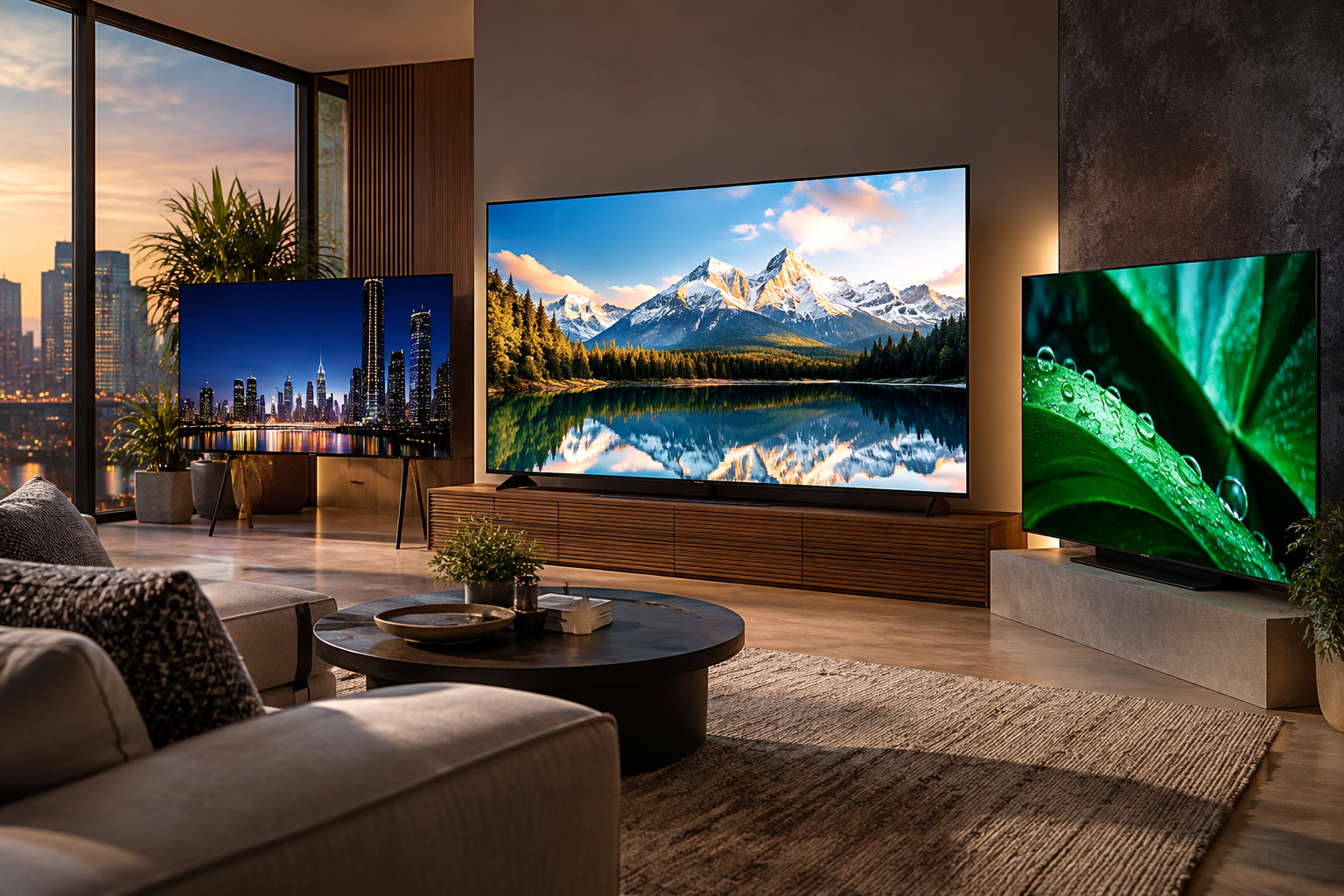
Asking for the best TV brand in 2026 sounds simple, but the answer depends on what you value most. One brand may be especially attractive for films in a dark room, another may offer stronger gaming features, while a third may provide a larger screen for the money.
Brand reputation is useful, but it should not replace model-by-model research. TV performance can vary substantially between entry-level, mid-range and flagship sets from the same manufacturer. Features, panel types, software support, warranties and prices may also differ by country.
This guide explains how the major TV brands generally position themselves, which factors matter most, and what to check before buying a television in 2026.
Quick answer: which TV brand is best?
There is no universally best TV brand. As a general starting point:
- LG is often worth considering if you want a broad OLED range, strong contrast and gaming-focused features.
- Samsung may suit buyers seeking bright-room performance, a wide selection of large screens and a polished smart-TV platform.
- Sony is a strong option to investigate when natural-looking picture processing, motion handling and film presentation are priorities.
- TCL and Hisense may appeal to shoppers looking for competitive specifications or large screen sizes at a lower price, although exact performance and support vary by model and market.
- Panasonic, where available, may interest viewers who prioritise cinema-oriented picture presentation and careful calibration options.
These are broad tendencies rather than guarantees. The best purchase is usually the specific model that meets your needs, fits your room and is supported properly in your location.
What makes a TV brand “best”?
When comparing brands, consider the complete ownership experience rather than one headline specification.
1. Picture quality
Look beyond resolution. Modern 4K televisions can differ in black levels, brightness, colour accuracy, viewing angles, reflection handling, upscaling and motion processing.
OLED screens can produce very deep blacks because individual pixels can switch off. This can make them appealing for films and television watched in a dim or controlled-light room. Potential drawbacks include a higher purchase price in some markets, differences in full-screen brightness and the need to follow the manufacturer’s care guidance for long-term use.
Mini LED and other LED-backlit LCD televisions can offer high brightness and may be well suited to rooms with windows or strong ambient light. Their performance depends heavily on the backlight design, local-dimming implementation and image processing. Some sets may show blooming around bright objects on dark backgrounds.
QLED is generally a term associated with LCD televisions that use quantum-dot technology. It is not a single performance class: two QLED televisions can have very different contrast, brightness and motion characteristics.
2. Bright-room performance
If you watch during the day, maximum brightness is only part of the equation. A screen’s anti-reflection treatment, viewing angle and ability to maintain contrast in ambient light can be equally important.
Before buying, consider where the TV will sit relative to windows and lamps. A television with excellent dark-room contrast may not be the most comfortable choice for a bright living room, while a very bright set may be unnecessary in a darker space.
3. Film and television viewing
Film fans should examine black-level performance, motion handling, filmmaker-oriented picture modes, support for common high-dynamic-range formats and the quality of the TV’s processing. Brand reputation can provide a useful starting point, but reviews of the exact model are more informative than a logo alone.
4. Gaming features
Console and PC gamers should check the specifications rather than assume that a premium TV includes every feature they need. Important questions include:
- Does it support the refresh rate required by your console or PC?
- Are the necessary HDMI features available on enough ports?
- Does it support variable refresh rate?
- Is automatic low-latency mode available?
- How does the TV perform at the resolution and frame rate you actually use?
- Does the chosen screen size work comfortably for your seating distance?
Gaming performance can differ between screen sizes within the same series, so check the technical documentation for the exact model number.
5. Smart-TV software
The operating system affects app availability, navigation, voice controls, advertising, privacy settings and how long the interface remains convenient to use. Check that the streaming services you use are supported in your country and that the TV receives suitable software updates.
A fast, simple interface may be more valuable than a long feature list. If you prefer a particular streaming platform, you can also connect an external streaming device, although this adds another remote control and power requirement.
6. Sound quality
Thin televisions often have limited space for speakers. Some premium models sound better than others, but buyers should not assume that an expensive TV will replace a dedicated soundbar or home-cinema system.
Check whether the TV supports the audio connections and formats required by your existing equipment. If you plan to add a soundbar, confirm that the television has a suitable HDMI audio connection and that the arrangement will work with your other devices.
7. Reliability, warranty and support
Reliability is difficult to judge from brand reputation alone because it can vary by model, usage, manufacturing batch and region. Look at the warranty terms, the retailer’s return policy, the availability of local service and the cost or practicality of transporting a large screen if it needs attention.
Keep the receipt, model number and purchase documentation. Read the warranty exclusions carefully, particularly those concerning accidental damage, commercial use and installation.
Brand-by-brand guide
LG
LG is especially associated with OLED televisions, although it also sells LED-based models. Its OLED range can be attractive to viewers who value strong contrast, wide viewing angles and gaming features.
Consider LG if:
- You mostly watch films or series in a dim or moderately lit room.
- You want to compare several OLED options.
- You play games and want to investigate features such as high refresh rates and variable refresh rate.
Check carefully: the brightness, reflection handling, number of high-bandwidth HDMI ports, smart-TV interface and the differences between entry-level and flagship models.
Samsung
Samsung offers a broad range of LCD-based and OLED televisions. Its higher-end sets may appeal to shoppers who want strong brightness, large screen choices and a mature smart-TV ecosystem.
Consider Samsung if:
- Your room is bright and you want to investigate high-brightness options.
- You are comparing large screens or premium designs.
- You want a TV with a strong focus on connected features and gaming specifications.
Check carefully: the exact panel technology, support for the HDR formats you use, viewing-angle performance, reflection handling and the number of useful HDMI ports. Feature support can differ by model and region.
Sony
Sony is widely associated with image processing, motion presentation and a film-oriented approach to picture quality. Its televisions may be appealing to viewers who watch a mixture of high-quality streaming, broadcast content and older or lower-resolution material.
Consider Sony if:
- You value natural-looking images and careful motion handling.
- You watch varied content rather than only native 4K material.
- You prefer a television platform based on Google TV, where available.
Check carefully: gaming specifications, brightness, the number of HDMI 2.1-capable ports, software preferences and whether the price premium is justified by the features you will actually use.
TCL
TCL is often positioned as a value-focused brand, with some models offering large screens, local dimming or gaming features at prices below comparable premium sets. The product range can differ considerably between countries.
Consider TCL if:
- You want a large screen and are comparing value carefully.
- You are interested in Mini LED or advanced LCD features at a potentially lower cost.
- You are willing to compare independent reviews of the exact model.
Check carefully: uniformity, motion processing, upscaling, viewing angles, software responsiveness, build quality and local warranty support.
Hisense
Hisense offers a wide mix of LCD, Mini LED and, in some markets, OLED televisions. Its sets can be worth investigating when specifications and screen size are important to you.
Consider Hisense if:
- You are looking for a feature-rich television at a competitive price.
- You want to compare large-screen or high-brightness options.
- You are prepared to research the exact regional model.
Check carefully: picture processing, local-dimming behaviour, app support, operating-system version, panel uniformity and after-sales service in your area.
Panasonic
Panasonic televisions may appeal to buyers who prioritise cinema-style picture presentation and calibration controls, where the brand’s relevant models are sold. Availability and model ranges vary substantially by country.
Consider Panasonic if:
- You value accurate, film-oriented picture modes.
- You want to explore calibration options.
- You have access to local service and a suitable model in your market.
Check carefully: smart-TV features, gaming support, app availability, screen brightness, retailer support and the current local range.
How to choose the best TV brand for your room
For a dark cinema room
Start by comparing OLED models and high-quality local-dimming LCD televisions. Prioritise black levels, shadow detail, motion handling, colour accuracy and screen size. A television with extreme brightness may be less important than one that maintains convincing contrast in your viewing environment.
For a bright living room
Investigate bright LCD or Mini LED models as well as OLED options designed for brighter rooms. Pay close attention to reflections, viewing angles and the position of windows. A screen that looks impressive in a dark showroom may perform differently beside a large window.
For sports
Motion handling, screen uniformity and viewing angle are particularly important. If several people watch from different positions, a panel with stable off-axis picture quality may be preferable. Try to assess motion with real sports footage or consult reviews that test fast-moving content.
For console or PC gaming
Compare input lag, refresh rate, variable refresh rate, automatic low-latency mode, HDMI capability and the number of suitable ports. Also consider burn-in-related guidance for OLED use if you regularly display static interfaces for long periods.
For family streaming
Choose an interface that your household can use comfortably. Confirm app support, parental-control options, profile features, remote design and voice-control preferences. If the built-in platform is not ideal, budget for a streaming device rather than rejecting an otherwise suitable screen.
Questions to ask before buying
- What is the maximum amount I want to spend, including delivery, installation and possible audio equipment?
- How far will I sit from the screen?
- Is the room usually bright, dim or mixed?
- Do I need OLED, or would a good LCD or Mini LED TV meet my needs?
- Which gaming features and HDMI connections are essential?
- Which streaming apps must work without an external device?
- Will several people watch from wide angles?
- Do I need a wall-mountable design, and is the wall suitable for the TV’s weight?
- What warranty and repair support are available locally?
- Am I comparing the exact model number rather than only the brand?
Common buying mistakes
- Choosing by brand alone: an entry-level model from a respected brand may not outperform a well-reviewed mid-range model from another manufacturer.
- Focusing only on 4K: resolution does not tell you about contrast, brightness, processing or motion.
- Buying the largest screen available: a screen that is too large for your room can be uncomfortable, especially with lower-quality content.
- Ignoring reflections: a glossy or highly reflective screen may be frustrating in a bright room.
- Assuming every HDMI port has the same capabilities: read the port specifications for the exact model.
- Overlooking sound: budget for a soundbar or other audio solution if built-in speakers are unlikely to meet your expectations.
- Relying on showroom settings: retail displays are often configured for a bright environment and may not represent home viewing.
How to compare two TVs fairly
Write down the features you genuinely need, then compare the models against the same checklist. Look at independent tests of the exact model, not just the product family. Check measurements for brightness, contrast, input lag and power use where available, but remember that testing methods can differ.
Read owner feedback for recurring issues, while treating isolated complaints cautiously. Confirm the return window, delivery inspection process, warranty coverage and whether the retailer is authorised to sell the product in your region.
Frequently asked questions
Is OLED better than QLED?
Neither is automatically better for everyone. OLED can offer excellent black levels and wide viewing angles, while QLED and other LCD televisions may offer strong brightness and value. The best choice depends on room lighting, content, price and your tolerance for each technology’s trade-offs.
Is Samsung or LG the better TV brand?
It depends on the models being compared. LG may be a natural starting point for OLED-focused shoppers, while Samsung offers a broad mix of bright LCD, Mini LED and OLED televisions. Compare the exact models for brightness, contrast, gaming support, software and price.
Is Sony worth the extra cost?
That depends on whether you value the features in the particular Sony model, such as processing or motion presentation, enough to justify its price. Compare it with similarly priced alternatives and consider the features you will use every day.
Are TCL and Hisense reliable choices?
They can be worth considering, especially for shoppers focused on screen size and specifications. Reliability and service experiences can vary by model and country, so check local warranty coverage, retailer support and reviews of the exact television.
What TV size should I buy?
There is no single correct size. Consider seating distance, room layout, the quality of the content you watch and your comfort with a more immersive image. Measure the available space and check the TV’s stand width before ordering.
Should I buy a TV with built-in streaming?
Built-in streaming is convenient, but it should not be the only reason to choose a television. Confirm the apps you need and consider whether the TV’s software is responsive and likely to suit your household. An external streaming device can provide an alternative.
Do I need a soundbar?
Not necessarily, but a soundbar can improve dialogue clarity, volume and overall impact compared with many thin-TV speakers. Whether it is worthwhile depends on the television, room and your expectations.
Bottom line
The best TV brand in 2026 is the one that offers the right combination of picture quality, room performance, gaming capability, software, sound, warranty and value for your situation. Begin with your viewing habits and room, choose the display technology that fits them, and then compare specific models from brands with dependable local support.
Before purchasing, verify the current specifications, price, availability, software features and warranty for your country. Product ranges can change during the year, and a television advertised as a premium model may still have compromises that matter to you.
Disclaimer: This is general consumer information, not professional purchasing, financial or technical advice. TV specifications, prices, availability, warranty terms and consumer rights vary by country and can change over time. Check the manufacturer’s documentation and local retailer terms before buying.