There is no single pair of earbuds that is best for everyone. The right choice depends on how you listen, which devices you use, how much you value comfort and whether you need features such as active noise cancellation, secure exercise fit or strong call quality.
This guide focuses mainly on wireless in-ear earbuds, often called true wireless earbuds. It covers the most important specifications, common trade-offs and practical questions to ask before buying.
Quick answer: what makes earbuds “the best”?
The best earbuds for you should meet five basic requirements:
- They fit securely and comfortably for the length of time you intend to wear them.
- They sound good to you, with a tuning that suits your music, podcasts, films or games.
- They work reliably with your phone, tablet or computer.
- The battery and charging case fit your routine.
- They include only the features you will actually use, rather than charging you for unnecessary extras.
Start with your main use case
Before comparing brands or specifications, decide where and how you will use the earbuds. A good pair for commuting may not be ideal for exercise or office calls.
Everyday listening
For general use, prioritize comfort, dependable Bluetooth performance, clear sound and a case that is easy to carry. A companion app can be useful if it offers equalizer controls, firmware updates and the ability to locate or customize the earbuds.
Travel and commuting
Active noise cancellation can reduce steady background sounds such as aircraft engines, trains and air-conditioning. It is less effective against every sudden or irregular sound, and it does not eliminate the need to remain aware of your surroundings in public places.
Also look for a comfortable transparency or ambient mode. This lets outside sound pass through when you need to hear announcements or speak with someone without removing the earbuds.
Work and phone calls
For calls, microphone performance matters as much as speaker quality. Consider earbuds with effective wind-noise reduction and voice processing, but remember that performance can vary depending on the phone, software and environment. If you regularly work in a noisy location, a headset with a boom microphone may still provide clearer speech than compact earbuds.
Exercise and outdoor use
A secure fit is essential for running, walking and gym sessions. Earbuds with different tip sizes, stabilizing wings or ear hooks can help, although these features may make them bulkier.
Check the product’s stated water- and sweat-resistance rating. Water resistance is not the same as waterproofing, and protection can decrease with age, damage or exposure to substances such as soap and salt water. The charging case may have a different rating—or no water resistance at all.
Gaming and video
For games and video, low audio delay is important. Standard Bluetooth connections can introduce a noticeable gap between picture and sound, while a dedicated gaming mode or compatible wireless transmitter may reduce it. Compatibility should be checked carefully, especially when using consoles, computers or devices that do not support the same wireless features.
Key decision factors
1. Fit and comfort
Fit affects comfort, sound quality, noise isolation and bass response. A poor seal can make music sound thin and can encourage users to increase the volume.
Look for several ear-tip sizes and, where possible, try the earbuds for an extended period before deciding. Ear shapes vary, so reviews and specifications cannot guarantee that a particular design will suit you.
Open-fit earbuds can feel less intrusive and allow more awareness of the environment, but they generally provide less passive isolation and may deliver less consistent bass than sealed in-ear designs.
2. Sound quality
Sound quality is partly technical and partly personal. Some listeners prefer a neutral presentation, while others prefer stronger bass or brighter detail. Useful features include:
- Equalizer controls: Let you adjust the sound to your preference.
- Customizable sound profiles: May adapt the tuning to your hearing or listening habits.
- Good channel balance: Helps the left and right earbuds sound consistent.
- Clear speech reproduction: Important for podcasts, audiobooks and calls.
Do not judge sound quality from codec support alone. A high-quality codec cannot compensate for an uncomfortable fit, poor tuning, weak source material or a device that does not support that codec.
3. Active noise cancellation and transparency mode
Active noise cancellation, or ANC, uses microphones and signal processing to reduce some external sounds. Its effectiveness depends on the earbuds’ design, fit, software and the type of noise around you.
ANC may be valuable if you travel or work in consistently noisy environments. It may be less important if you mostly listen at home or prefer to hear your surroundings. Transparency mode is useful for conversations and situational awareness, but its naturalness varies between products.
4. Microphone and call performance
Earbud microphones are affected by wind, traffic, room acoustics and the placement of the microphones. Look for independent tests that include sample recordings in quiet and noisy settings rather than relying only on a claim such as “crystal-clear calls.”
For frequent online meetings, also check whether the earbuds support the operating system and conferencing applications you use. Some features may work fully only with particular phones or companion software.
5. Battery life and charging
Manufacturers commonly quote separate figures for the earbuds and the charging case. Real-world listening time can be lower when ANC, high volume, calls or certain connection features are active.
Consider:
- How long the earbuds last on one charge.
- How many additional charges the case provides.
- How quickly a short charge restores listening time.
- Whether the case uses USB-C or another connector.
- Whether wireless charging is useful for your setup.
Built-in batteries gradually lose capacity. A pair with a replaceable battery or accessible repair options may have advantages for long-term ownership, although availability varies by product and region.
6. Device compatibility and ecosystem features
Most modern wireless earbuds can connect to a wide range of Bluetooth devices, but advanced features may be limited by the platform. These can include automatic switching, spatial audio, hands-free assistants, device-finding networks and one-tap pairing.
If you use both a phone and a computer, confirm whether the earbuds support multipoint connection or reliable automatic switching. These functions are not always identical, and some products require you to select a device manually.
7. Durability and repairability
Compact earbuds are exposed to sweat, drops, dust and repeated charging. A stated protection rating can help you compare products, but it does not guarantee resistance to every type of liquid or accident.
Also consider the practical lifespan of the charging case, the availability of replacement tips and whether the manufacturer offers repairs or replacement components. If one earbud is lost, replacement policies may differ significantly between brands.
8. Controls and software
Touch controls can be convenient, but accidental taps are possible. Physical buttons may provide more predictable feedback, though they can press the earbud further into the ear.
Review the companion app’s permissions, update process and customization options. Useful controls may include volume, playback, calls, ANC modes, listening modes and a battery indicator. Avoid choosing a product solely because it has many settings; the important question is whether those settings are easy to use.
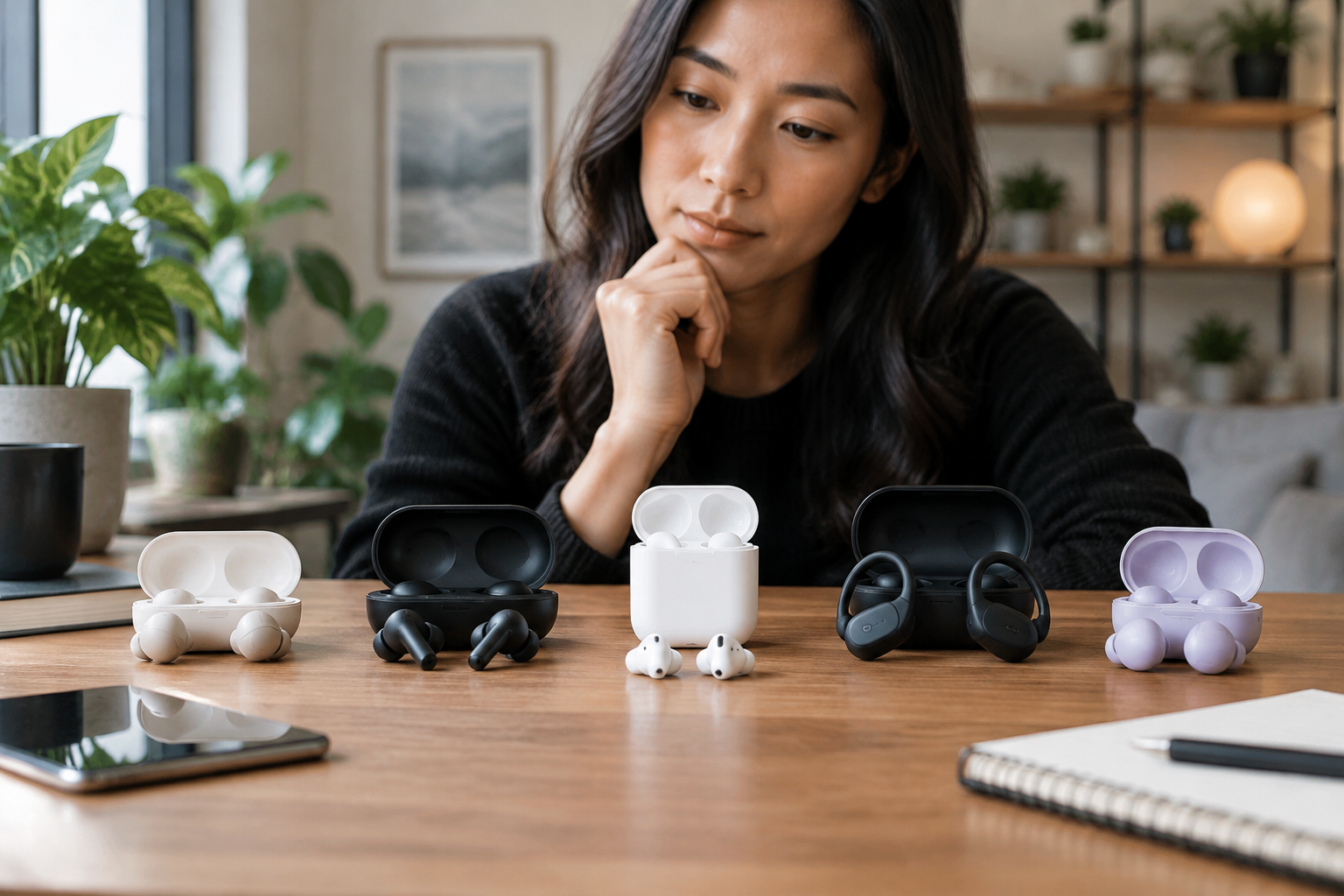
Earbud types compared
| Type | Strengths | Potential drawbacks |
|---|---|---|
| Sealed in-ear wireless earbuds | Compact, portable, often good passive isolation and bass | Fit can feel intrusive; comfort varies by ear shape |
| Open-fit wireless earbuds | Greater awareness of surroundings and less blocked-ear sensation | More sound leakage and usually less isolation |
| Sport earbuds with stabilizers or hooks | More secure during movement | Can be larger or less comfortable for casual use |
| Neckband wireless earbuds | Harder to lose and sometimes longer-lasting | Less compact and less common than fully wireless designs |
| Wired in-ear earphones | No battery charging and often broad device compatibility | Require a cable and may need an adapter |
How to compare earbuds without being misled by specifications
Specifications are useful, but they do not tell the whole story. Treat unusually precise performance claims with caution unless they are supported by independent testing.
- Battery claims: Check the conditions under which the quoted figure was measured.
- Noise cancellation claims: Results depend on frequency, fit and surroundings.
- Water-resistance claims: Confirm whether the rating applies to the earbuds, the case or both.
- Audio codecs: Verify that your source device supports the relevant codec.
- Spatial audio: Check which apps, content and devices are compatible.
- Reviews: Prefer tests that discuss comfort, call quality and long-term use, not just first impressions.
A practical buying process
- Set your priorities. Choose the two or three features that matter most, such as comfort, ANC, calls or exercise stability.
- Confirm device compatibility. Check your phone, computer, tablet and any gaming hardware.
- Shortlist a few designs. Compare fit, controls, battery, water resistance and software support.
- Check the return policy. Fit and comfort are difficult to evaluate from specifications alone.
- Test them in realistic situations. Try music, calls, walking, background noise and extended wear.
- Keep the purchase sustainable. Consider warranty coverage, repair options, replacement tips and the likely battery lifespan.
Common mistakes to avoid
- Buying based only on brand reputation or a single review.
- Assuming the highest price guarantees the best fit or sound.
- Ignoring the charging case’s size and battery performance.
- Using earbuds at high volume to overcome a poor seal or noisy surroundings.
- Assuming a water-resistant rating makes the earbuds suitable for swimming.
- Overlooking the cost or availability of replacement parts and a single lost earbud.
- Choosing features that are incompatible with your main device.
Practical questions to ask before buying
- Will I wear these for short sessions or several hours at a time?
- Do I need to hear traffic, announcements or colleagues while listening?
- Are clear calls more important to me than maximum music detail?
- Will I use them for exercise, and does the protection rating suit that use?
- Do I switch between a phone and a computer frequently?
- Can I use the main features with my operating system?
- What happens if the case or one earbud is lost?
- Can I return them if the fit causes discomfort?
Frequently asked questions
Are expensive earbuds always better?
No. More expensive models may offer stronger noise cancellation, better materials, advanced software or improved microphones, but those advantages may not matter to every listener. Fit, comfort and compatibility can be more important than price.
Is active noise cancellation worth it?
It can be worthwhile for travel, commuting or consistently noisy workplaces. If you mainly listen in quiet surroundings, a comfortable design with good sound may provide better value.
Which earbuds are best for phone calls?
The best choice depends on the phone, software and environment. Look for independent microphone tests in wind and background noise, and consider whether your work requires the additional microphone quality and comfort of a headset.
How important is the earbud fit?
It is fundamental. Fit influences comfort, bass, passive isolation, ANC performance and the likelihood that the earbuds will fall out. A model with several tip sizes is often easier to adapt.
Can earbuds be used while exercising?
Many are designed for exercise, but suitability depends on secure fit, sweat protection and the activity. Check the product’s protection information, keep the case dry and follow the manufacturer’s care instructions.
How long should wireless earbuds last?
The useful lifespan varies with battery wear, physical damage, software support and how heavily the earbuds are used. Battery capacity normally declines over time, so warranty terms, repairability and replacement options are worth checking before purchase.
Do Bluetooth earbuds work with every phone?
Basic Bluetooth audio often works across many phones, but pairing methods and advanced features can vary. Confirm compatibility for multipoint, spatial audio, high-quality codecs, device finding and companion apps.
What volume is safe?
Keep listening at the lowest comfortable level, take breaks and be especially careful in noisy environments, where it is easy to turn the volume up. If you experience ringing, discomfort or reduced hearing, stop listening and seek advice from a qualified healthcare professional.
Bottom line
Choosing the best earbuds is mainly an exercise in matching priorities. Start with fit and your main use case, then compare sound, noise control, call quality, battery life, durability and device compatibility. A well-fitting pair with the features you will genuinely use is usually a better choice than a more expensive model selected only for its specification sheet.
Disclaimer: This article provides general consumer information, not personalized technical, medical or purchasing advice. Product features, compatibility, warranties and return rights vary by manufacturer and jurisdiction. Check current details with the manufacturer and retailer before buying.