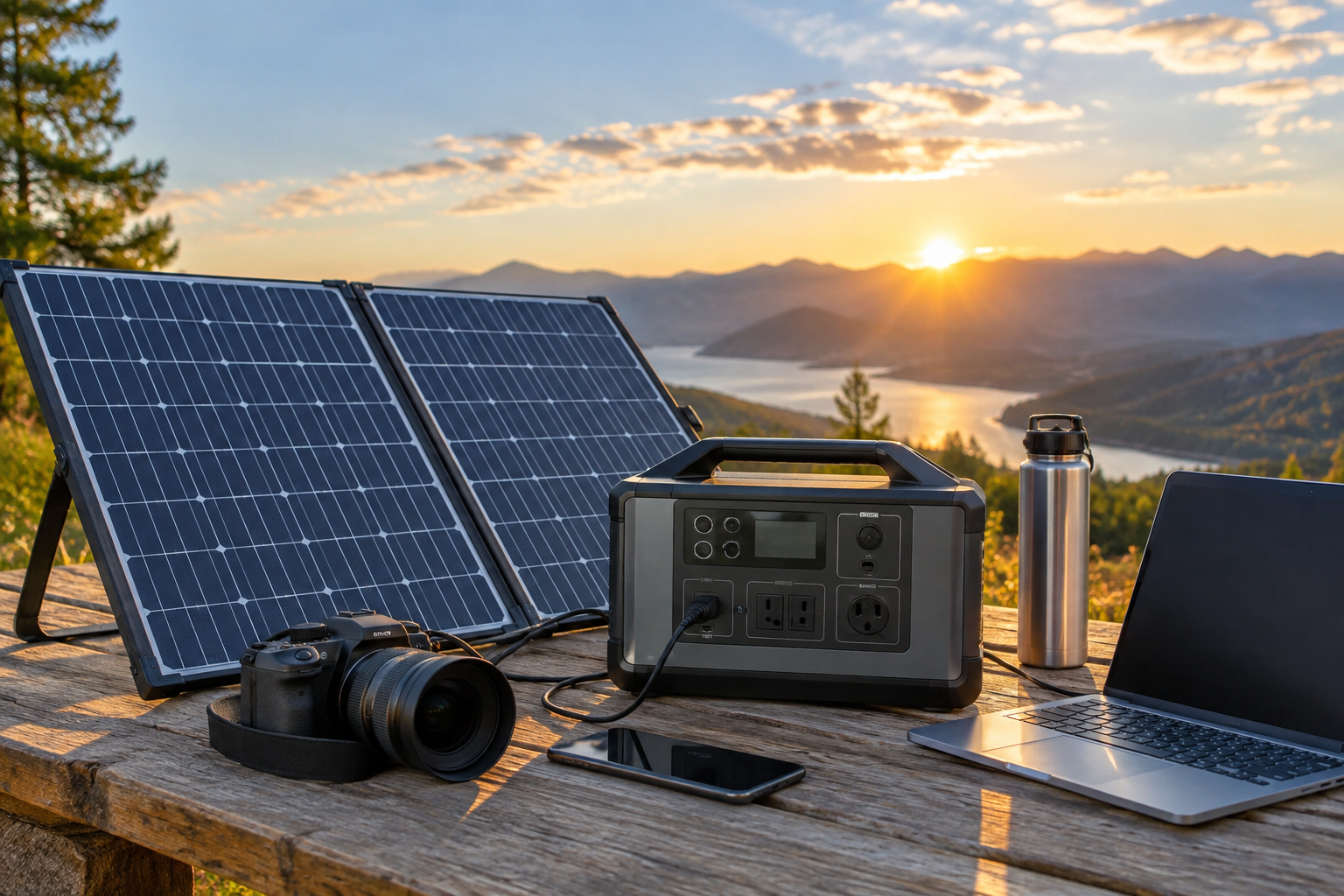
Solar power kits combine several components that generate electricity from sunlight and make it usable for appliances, electronics, vehicles, or battery storage. Depending on the design, a kit may include solar panels, a charge controller, an inverter, batteries, mounting hardware, cables, connectors, and monitoring equipment.
Some kits are intended for small portable devices, while others are designed to support selected household circuits or off-grid buildings. The right choice depends less on the panel wattage shown on the box than on your energy use, local sunlight, battery needs, installation conditions, and electrical requirements.
What is a solar power kit?
A solar power kit is a packaged group of components intended to work together as a small solar-electric system. It may be portable and plug-and-play, or it may require professional design and installation.
Most systems perform four basic functions:
- Generation: Solar panels convert sunlight into direct-current electricity.
- Control: A charge controller regulates energy flowing to a battery and helps protect the battery from unsuitable charging conditions.
- Storage: A battery stores electricity for use when sunlight is weak or unavailable.
- Conversion: An inverter converts battery or solar-panel electricity into the type of alternating-current power used by many household appliances.
Not every kit contains all four elements. A grid-tied kit may use an inverter but no battery, while a small USB charging kit may contain a panel and a simple output port without a separate inverter.
Common types of solar power kits
Portable solar charging kits
These usually include a foldable or compact panel, a charge controller or power station, and connection options for phones, cameras, lights, or other small devices. They are useful for camping, travel, field work, and emergency charging, but their output can be limited by cloud cover, panel orientation, and the small size of the solar array.
Solar panel and battery kits for remote equipment
These systems can power equipment such as sensors, electric gates, security devices, signs, pumps, or communications equipment. They need careful sizing because the equipment may operate continuously and must remain powered during periods of poor sunlight.
Off-grid solar kits
Off-grid kits are designed for cabins, workshops, boats, recreational vehicles, or other locations without a dependable utility connection. They generally include batteries and an inverter. A generator or another backup source may still be needed for extended cloudy conditions or unusually high demand.
Home backup kits
Home backup systems typically use a battery, inverter, and controls to supply selected loads during a grid outage. They may support lights, refrigeration, communications equipment, medical equipment where appropriately designed, or essential outlets. They are not automatically capable of powering an entire home, and some loads require substantial starting power.
Grid-connected solar kits
Grid-connected systems send electricity to household circuits and may export surplus energy to the utility network, subject to local rules and approval. These systems can involve permits, inspections, utility interconnection requirements, and specific equipment. They should be designed and installed in accordance with applicable electrical standards.
Key components and what they do
Solar panels
Panel output is commonly expressed in watts under specified test conditions. Actual production varies with sunlight intensity, shading, temperature, panel angle, dust, wiring losses, and equipment limits. A panel's headline wattage should therefore be treated as a rated capacity, not a guaranteed continuous output.
Charge controller
A charge controller manages charging from the panels to the battery. Two common categories are PWM and MPPT. MPPT controllers can make better use of certain panel and battery voltage combinations, but suitability depends on the complete system design. Check the controller's maximum solar input voltage, current, and supported battery chemistry.
Battery
Battery capacity is often stated in watt-hours or amp-hours. Important factors include usable capacity, maximum continuous output, surge capability, charging limits, operating temperature, cycle life, maintenance needs, and safety features.
Common battery chemistries include lead-acid and lithium-based batteries. Lead-acid batteries may require more attention to charging and ventilation, depending on the type. Lithium-based batteries can offer useful energy density and integrated protection, but they still require compatible charging equipment and correct installation. Do not mix batteries, chargers, or settings without confirming compatibility.
Inverter
An inverter converts direct-current electricity into alternating-current electricity. Its continuous rating should cover the expected running load, while its surge rating should accommodate appliances with motors or compressors, such as refrigerators, pumps, and some power tools.
Pure sine-wave inverters are generally the safer choice for sensitive electronics and equipment with motors, but the appropriate specification depends on the loads. Also check the inverter's input voltage, efficiency, low-voltage cutoff, cooling requirements, and protection features.
Mounting, wiring, and protection
Mounting hardware must suit the roof, ground, vehicle, or other surface. Cables and connectors must be rated for the expected current, voltage, outdoor exposure, and temperature. Fuses, breakers, disconnects, grounding, and surge protection may be required depending on the system and location.
How to size a solar power kit
Start with energy use rather than choosing a kit based only on its panel wattage. A basic sizing process is:
1. List the devices and their power
Record each device's wattage and the number of hours it will run per day. If a device lists volts and amps instead of watts, multiply volts by amps to estimate watts. For alternating-current equipment, use the appliance label or manufacturer information where available.
| Device information | Basic calculation |
|---|---|
| Energy used by one device | Watts × hours of operation = watt-hours |
| Total daily energy | Add the watt-hours for all devices |
| Approximate panel requirement | Daily watt-hours ÷ usable sunlight hours, then allow for system losses |
2. Account for starting loads
Some appliances draw more power when they start than they use while running. A refrigerator, pump, compressor, or power tool may therefore require an inverter with an adequate surge rating even if its normal wattage appears modest.
3. Estimate battery capacity
Battery capacity should cover the energy needed between charging periods, with a suitable reserve. The calculation must account for the battery's recommended depth of discharge, inverter losses, temperature effects, and any requirement for several days of autonomy.
For example, a system intended only for evening lighting may need much less storage than one expected to operate refrigeration, communications, and tools overnight. Oversizing the battery without increasing the available charging capacity can also leave the system regularly undercharged.
4. Consider the available sunlight
Solar production changes by season, weather, shading, orientation, and location. Use conservative assumptions when the system must operate reliably. A kit that works well during bright summer days may not meet the same demand during winter or extended cloudy periods.
Decision factors before buying
- Purpose: Decide whether the kit is for portable charging, occasional backup, daily off-grid use, or grid-connected generation.
- Loads: Identify both total energy consumption and the highest simultaneous power demand.
- Portability: Foldable panels and power stations are convenient, while fixed systems may provide more capacity and durability.
- Battery chemistry: Compare usable capacity, maintenance, temperature limits, safety requirements, and expected service life.
- Expandability: Check whether additional panels or batteries can be added later and whether the controller and inverter support expansion.
- Weather and environment: Consider rain, salt air, dust, freezing temperatures, heat, vibration, and physical security.
- Installation: Determine whether the system is genuinely user-installable or requires an electrician, structural assessment, permits, or utility approval.
- Compatibility: Confirm voltage, connector type, polarity, battery settings, inverter waveform, and maximum input and output ratings.
- Maintenance and support: Review manuals, replacement parts, warranty terms, software requirements, and the availability of technical assistance.
- Safety: Look for clear instructions, appropriate protective devices, certified or tested equipment where relevant, and a design that prevents accidental contact with live conductors.
Portable versus fixed solar kits
Portable kits are easier to move and may require little installation. They suit temporary use and smaller loads, but they can have lower capacity and may be less convenient for daily household use.
Fixed kits can use larger panels, permanent wiring, and more substantial batteries. They may deliver more predictable performance, but mounting, weatherproofing, electrical protection, structural loading, and local approvals become more important.
Installation and safety considerations
Read the complete installation instructions before connecting components. Follow the manufacturer's limits for panel voltage, battery voltage, current, temperature, cable size, and connector arrangement.
Do not assume that a kit advertised as simple to install can be connected directly to household wiring. Systems that connect to a building or utility supply may require a qualified installer, inspection, permits, or utility authorization. Requirements vary by country, region, building type, and system design.
Keep batteries away from unsuitable heat, moisture, ignition sources, and places where they can be damaged. Provide the ventilation specified for the battery type. Protect cables from abrasion and accidental short circuits, and use correctly rated fuses or breakers. Never bypass a battery-management system or protective device to solve a charging or performance problem.
Common mistakes to avoid
- Choosing panels based on peak wattage without calculating daily energy needs.
- Ignoring inverter surge requirements for motors and compressors.
- Assuming a battery's stated capacity is fully usable in every operating condition.
- Connecting incompatible panels, batteries, controllers, or inverters.
- Underestimating shading from trees, buildings, railings, or seasonal changes.
- Using extension cords or connectors that are not rated for the system's current and environment.
- Expecting a small kit to run heating, cooling, cooking appliances, or power tools for long periods.
- Installing a grid-connected system without checking local approval and interconnection requirements.
- Failing to plan for cloudy weather, battery replacement, or a backup source.
Practical questions to ask before purchase
- What devices must the kit run, and for how many hours each day?
- What is the highest starting or surge load?
- Will the system be used daily, occasionally, or only during outages?
- How much sunlight reaches the proposed panel location throughout the year?
- How much battery energy is actually usable?
- Can the kit be expanded, and what are the limits on expansion?
- Which components are included, and which cables, fuses, mounts, or adapters must be purchased separately?
- Are the connectors and voltage ratings compatible with the equipment already owned?
- What maintenance, storage, and temperature precautions apply?
- Do local electrical, building, fire, or utility rules affect installation?
Frequently asked questions
Can a solar power kit run a whole house?
Some large, professionally designed systems can support a home or selected household circuits, but many consumer kits are intended for smaller loads. Whole-home operation depends on energy consumption, peak demand, battery capacity, panel capacity, backup arrangements, and the electrical design of the property.
Will a solar kit work at night?
Panels do not produce useful power without adequate sunlight. A kit can operate at night if it has stored energy in a battery or another available power source.
Can I add more panels later?
Possibly. The charge controller, inverter, wiring, battery, mounting system, and protective equipment all have maximum ratings. Expansion should be checked against the complete system design rather than assumed to be safe.
How long will a solar battery last?
Service life varies with chemistry, temperature, charging practices, depth and frequency of discharge, storage conditions, and product design. Review the manufacturer's specifications and treat advertised cycle figures as conditions-based estimates rather than a guarantee of a particular lifespan.
Do solar kits work in cloudy weather?
Solar panels can produce some electricity in diffuse light, but output is generally lower than in strong direct sunlight. The effect depends on the weather, location, panel technology, shading, and system configuration. Battery storage or another backup source may be needed for reliability.
Is a solar power kit the same as a solar generator?
The terms are used inconsistently. A so-called solar generator often means a portable battery power station paired with solar panels, while a solar power kit may refer to a broader set of panels, controller, battery, inverter, and accessories. Check the included components rather than relying on the label.
Can I connect a kit to a wall outlet to power my home?
Do not use improvised connections or backfeed a building through an ordinary outlet. Household backup systems require an appropriate transfer arrangement and protection designed for the property. Consult a qualified electrician where building wiring is involved.
Bottom line
The best solar power kit is the one that matches the intended loads, available sunlight, storage needs, environment, and installation requirements. Begin with an energy and surge-load inventory, check every component's electrical limits, allow for weather and system losses, and confirm whether professional installation or local approval is required. A smaller, correctly sized system is generally more useful than a larger kit whose battery, inverter, or wiring cannot support the way you plan to use it.
Disclaimer: This article provides general consumer information, not electrical, engineering, financial, legal, or safety advice for a specific property or installation. Equipment specifications, electrical codes, permits, utility rules, warranties, and installation requirements vary by jurisdiction and product. Consult the manufacturer's instructions and a suitably qualified professional before connecting a system to building wiring, installing batteries, or undertaking work that may affect safety or grid connection.